
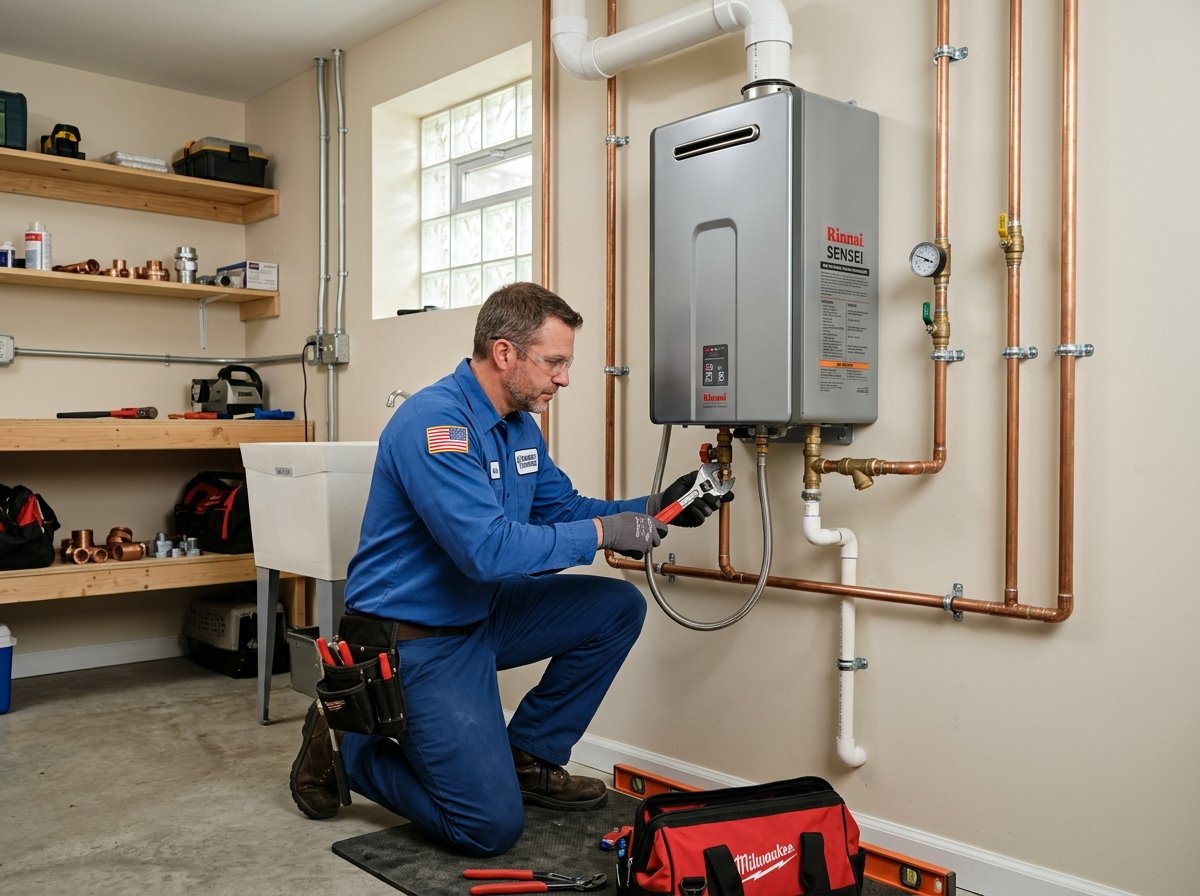
Customer Reported Problem
The Lancaster homeowner reported lukewarm water during morning showers, metallic discoloration in the hot water supply lines, and water pooling around the base of their 11-year-old atmospheric gas water heater. With severe winter conditions in Central Pennsylvania, immediate domestic hot water restoration was essential.
On-Site Diagnostic Assessment
Upon initial examination, the plumbing technician confirmed active weeping from the bottom tank seam beneath the outer jacket insulation. A digital pressure test indicated municipal incoming water pressure at 72 PSI with evidence of closed-loop thermal pressure spikes exceeding 90 PSI due to a failed thermal expansion tank diaphragm.
Because internal glass lining degradation and tank wall corrosion cannot be reliably patched, full system replacement was recommended in accordance with standard plumbing safety protocols.
Work Performed
The technician isolated the gas line, shut off the domestic cold water supply, and performed a controlled tank drain using an electric transfer pump to prevent basement floor water damage.
- Safely removed and recycled the corroded 50-gallon water heater.
- Installed a new high-efficiency 50-gallon atmospheric natural gas water heater.
- Replaced aging galvanized nipples with dielectric brass unions to prevent galvanic corrosion.
- Installed a new 2.1-gallon potable thermal expansion tank charged to match household water pressure.
- Replaced the temperature and pressure (T&P) relief valve and piped discharge to within 6 inches of the floor.
- Rebuilt rigid copper cold and hot water header lines with lead-free soldered fittings.
- Installed a quarter-turn brass ball valve for rapid emergency water shut-off.
Safety Testing & Verification
Following installation, the gas supply was leak-tested using electronic combustible gas detection instruments and non-corrosive bubbling solution. The flue draft was inspected using smoke testing to verify proper chimney draft and prevent carbon monoxide backdrafting into the living space.
The tank was filled, purged of air, and brought up to a factory-recommended set point of 120°F. Hydrostatic inspection confirmed zero leaks across all mechanical connections.
Homeowner Advice & Ongoing Care
To maximize the lifespan of the new water heater in Lancaster's moderately hard water conditions, the homeowner was advised to schedule annual sediment flushing and inspect the sacrificial anode rod every three years.