
- What Is a Hidden Water Leak?
- 1. Unexpected Water Bill Spikes
- 2. Damp Walls and Ceilings
- 3. Musty Odors and Mold
- 4. Peeling Paint and Water Stains
- 5. Reduced Water Pressure
- Simple Water Meter Checks
- Slab and Underground Leak Signs
- Warning Signs vs. Causes Table
- When Professional Detection Is Needed
- How to Reduce Water Damage
- Frequently Asked Questions
1. Unexpected Water Bill Spikes
One of the most reliable early indicators of a hidden plumbing leak is an unexplainable jump on your monthly utility statement from the City of Lancaster Water Bureau or local municipal authority.
If your family's daily habits have not changed—no extra guests, no garden irrigation, no pool filling—yet your water consumption has doubled, pressurized water is escaping continuously somewhere in your system.
2. Damp Walls and Ceilings
Drywall and plaster are porous materials that absorb moisture like sponges. If an in-wall supply line or second-floor bathroom drain develops a slow leak, moisture travels along the horizontal wooden framing members before saturating drywall.
Run your hand along interior partition walls, especially behind bathrooms, kitchen sinks, and laundry hookups. If drywall feels soft, cool, or spongy to the touch, moisture is trapped behind the wall.
3. Musty Odors and Mildew
Mold spores require only 24 to 48 hours of consistent moisture, warmth, and an organic food source (such as the paper backing on fiberglass insulation or drywall gypsum) to colonize.
If you detect an earthy, damp, or musty basement smell in upstairs bedrooms, closets, or living rooms—even after thorough cleaning—water is evaporating behind walls or beneath flooring.
4. Peeling Paint or Water Stains
Water trapped behind latex paint breaks the adhesive bond between the paint film and the drywall, causing paint to bubble, stretch, or peel like wallpaper. On ceilings, slow water leaks often create circular brownish, yellowish, or copper-colored water stains with dark outer rings.
5. Reduced Whole-Home Water Pressure
A major split or corroded perforation along an underground water service line or main copper riser allows substantial volume to escape, reducing water volume reaching second-story faucets and showerheads.
Simple Water Meter Checks (The 3-Step Test)
Homeowners can verify whether their home has an active pressurized water leak in less than an hour using their municipal water meter:
- Shut Off All Fixtures: Ensure every faucet, shower, toilet, washing machine, dishwasher, and outdoor hose bib is completely turned off. Make sure the refrigerator ice maker is not actively cycling.
- Locate the Water Meter: Your meter is typically located in the basement along the front wall or outside in a ground meter pit near the curb. Open the meter cover.
- Check the Low-Flow Leak Indicator: Look for a small red triangle, rotating gear, silver asterisk, or digital decimal display. If the dial moves even slightly while all household valves are closed, water is leaking under pressure.
Slab and Underground Leak Warning Signs
Many Pennsylvania homes feature slab-on-grade additions, finished basements, or ground-level utility spaces where copper pipes are encased in concrete. Slab leaks present distinct warning signs:
- Warm Floor Spots: Localized warm or hot spots on tile, hardwood, or carpet indicate a hot water line leak beneath the slab.
- Sounds of Rushing Water: Hearing faint water flow beneath your floor when all fixtures are completely off.
- Foundation Cracking or Shifting: Escaping water erodes soil supporting the concrete slab, causing cracks in basement floors or interior walls.
Hidden Leak Warning Signs vs. Likely Causes
| Observed Warning Sign | Probable Leak Location | First Step to Take | Professional Method Needed |
|---|---|---|---|
| Water meter dial spins with no fixtures running | Pressurized supply line, running toilet, or underground main. | Shut off toilet isolation valves to isolate fixture leaks. | Routine Pressure testing and line isolation. |
| Brown ceiling water ring beneath bathroom | Failed shower pan membrane, tub overflow gasket, or drain P-trap. | Avoid using upstairs tub; inspect drain trap under sink. | Moderate Drain camera inspection and pipe repair. |
| Warm spot on basement tile or carpet | Hot water copper supply line leaking beneath concrete slab. | Check water meter; feel surrounding floor areas. | Urgent Electronic acoustic listening and slab bypass. |
| Spongy drywall and peeling paint behind kitchen | Pinhole leak in copper or PEX supply line inside wall stud cavity. | Shut off main water valve if water begins weeping through. | Critical Thermal imaging and targeted section soldering. |
When Professional Leak Detection Is Needed
In the past, locating an in-wall or under-slab leak involved tearing down multiple drywall sections or jackhammering through finished tile floors on a guess. Modern leak detection eliminates destructive guesswork:
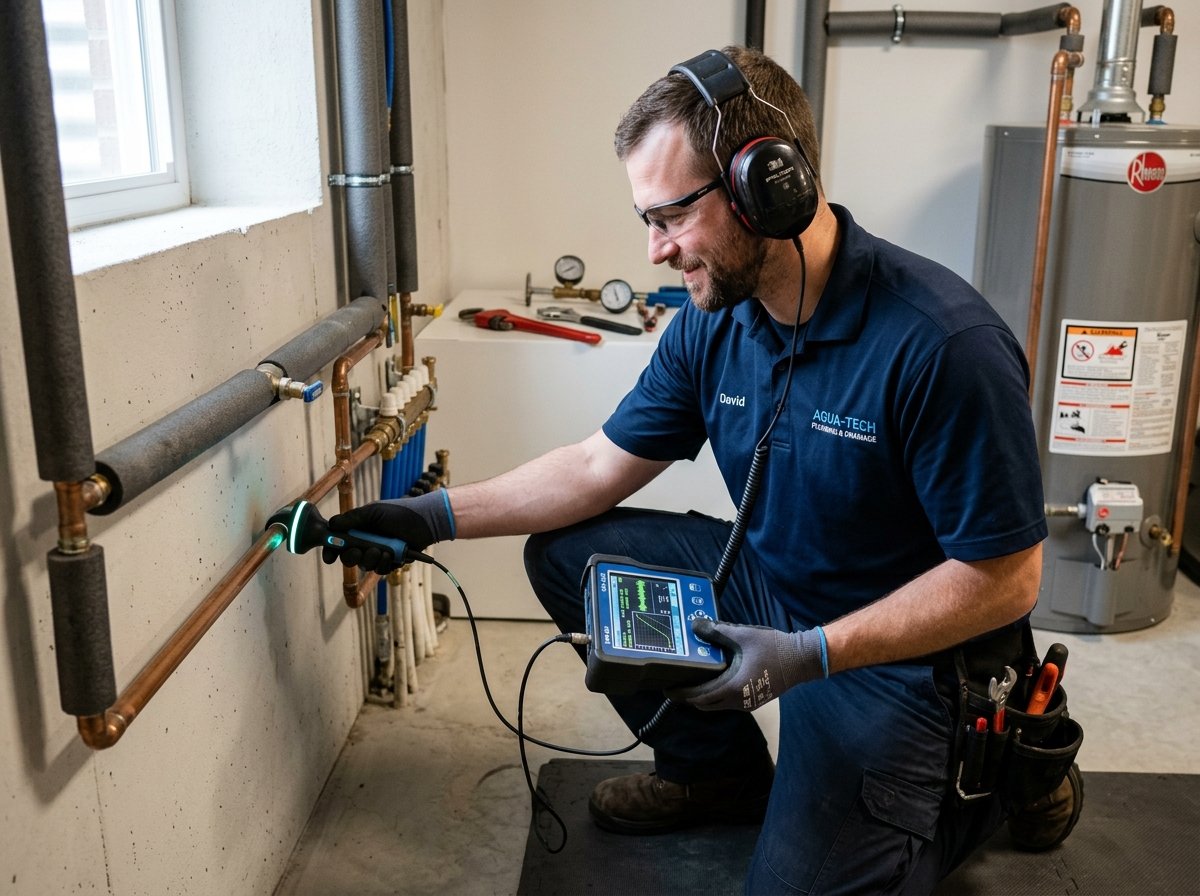
- Acoustic Listening Devices: Highly sensitive ground microphones amplify the distinct high-frequency sound of pressurized water escaping through microscopic pipe fissures.
- Thermal Infrared Cameras: Infrared imaging scans temperature differentials behind drywall, showing exact thermal moisture patterns without cutting walls.
- Tracer Gas Testing: Non-toxic nitrogen and hydrogen gas mixtures are introduced into empty lines to detect trace vapor escaping through foundations.
Learn more on our dedicated Lancaster Leak Detection and Pipe Repair service pages.
How to Reduce Water Damage While Awaiting Repair
- Shut off the main water supply valve to halt active water flow.
- Move furniture, area rugs, and electronics away from damp walls and ceilings.
- Set up oscillating fans and dehumidifiers to circulate air and reduce indoor humidity levels.
- Document damaged materials thoroughly with date-stamped photos before repairs begin.
Frequently Asked Questions
Can a hidden water leak cause mold growth?
Yes, mold spores thrive in dark, humid environments with cellulose food sources like drywall and wood framing. A slow, undetected water leak provides continuous moisture that can generate substantial hidden mold colonies within 48 to 72 hours.
Does homeowner insurance cover hidden water leak damage?
Most standard homeowner insurance policies cover "sudden and accidental" water discharge (such as a burst pipe). However, gradual damage from leaks that have existed for months may be excluded under wear-and-tear clauses. Prompt documentation and rapid repair help protect insurance claims.
What is a pinhole leak and why does it happen?
A pinhole leak is a tiny hole that develops in copper supply pipes due to pitting corrosion. Pitting is often caused by water chemistry (low pH, high dissolved oxygen), turbulent water velocity from oversized pumps, or electrical grounding currents travelling along copper piping.
How accurate is acoustic leak detection?
When performed by an experienced technician with professional electronic amplifiers and ground sensors, acoustic leak detection can pinpoint pressurized pipe leaks within a few inches—even through several inches of concrete slab foundation.
How do I arrange leak detection in Lancaster, PA?
Call Lancaster Rapid Plumbing at (717) 750-0500 to discuss your leak symptoms and schedule non-destructive leak detection across Lancaster County.
About Lancaster Rapid Plumbing Editorial Team
This guide was developed by our editorial team to help Lancaster, PA homeowners detect hidden water leaks early and prevent catastrophic structural water damage.
Service Notice: Lancaster Rapid Plumbing connects homeowners with independent, qualified plumbing contractors. All detection and repair services are performed by local plumbing technicians.